Research
Models that write code are here to stay, but most courses treat them as something to police, and most assessments grade only the final code. A passing test suite doesn’t show how the code was written or whether its author understood it. My research asks three questions about a person programming with a model: what to assess, how to assess it, and what the assessment predicts.
Assessment. We proposed a framework that scores a recorded programming session on five competencies: how the student breaks down the problem, plans, prompts, checks the model’s output, and steers an agent that goes wrong. It is a proposal, not yet a validated instrument. To make validation possible, I built much of AlgoArena’s assessment environment, an editor where the model can change files and run commands, and where every prompt, edit, test run, and diff review is saved as a replayable trace.
Teaching. We wrote an open curriculum for building software by directing a model: writing a specification, supervising coding agents, and checking what they produce. We are expanding it into a free textbook, Vibecoding: Introduction to Applied AI.
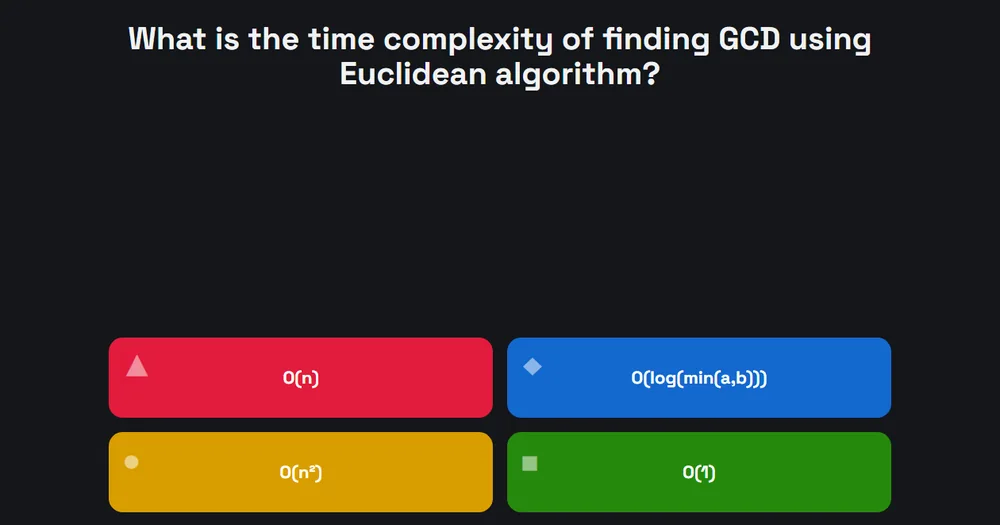
Practice in class. AlgoArena Classroom runs live quizzes in CS courses. Students predict a program’s output, give an algorithm’s running time, write code that is graded against test cases, or draw a data structure. Michael Wehar piloted it in his Competitive Coding Algorithms course (CS 283) at Bryn Mawr College in spring 2026. As of November 2026, eleven hosts with no tie to the project have run fifteen live quizzes for their own classes and groups, the largest with seventeen students. The pilot was too small to show an effect on learning, so a full course evaluation comes next.
From here I want to validate the framework with graders who rate sessions blind to it, train models that predict their ratings from session logs, and compare courses that teach AI-assisted programming openly with courses that don’t.
Before this I worked on applied machine learning. As an NSF REU fellow in Mohammed Kamruzzaman’s lab at the University of Illinois, I predicted egg viability and chick sex from daily hyperspectral images of incubating eggs, reaching 93.8% viability accuracy by day four with all model fitting kept inside the validation folds. I’m writing the manuscript as first author. At Swarthmore, advised by Gabriel Hope, I classified insect feeding behavior from electrical recordings for a USDA ARS project.